Mapungubwe National Park
A UNESCO World Heritage park at the Limpopo-Shashe confluence — the lost kingdom of Mapungubwe, baobabs, and big river country.
Trip Role
Ideal stay
Best for
Our take
The lost kingdom of Mapungubwe and a dramatic baobab-and-river park — a genuine anchor for long-tail travellers, and the one park that competes with Kruger on a different axis.
The lost kingdom of Mapungubwe and a dramatic baobab-and-river park — a genuine anchor for long-tail travellers, and the one park that competes with Kruger on a different axis.
- Trip Role
- Trip Anchor
- Ideal Stay
- 2–3 days
- Best For
- Long-tail travellers, archaeology and history readers, wilderness seekers.
- Skip If
- First-timers who need the Big Five guarantee.
- Go If
- You want the one Limpopo park that combines archaeology, scenery, and wildlife, away from Kruger's crowds.
- Worth Extra Drive
- 90 min
Why it's worth your time
A national park and UNESCO World Heritage site at the confluence of the Limpopo and Shashe rivers in the far north, where South Africa, Botswana, and Zimbabwe meet. Mapungubwe holds the remains of the Mapungubwe kingdom — a sophisticated trading state that flourished 900–1300 AD, before Great Zimbabwe, whose royal hilltop is crowned by the famous gold-foil rhinoceros. The park itself is dramatic — baobab-clad sandstone hills, the Limpopo riverine forest, and elephant and predator country. For long-tail travellers it's a genuine anchor — archaeology, scenery, and wilderness in one of the country's least-visited parks.
What we love
The Mapungubwe hilltop and the gold rhino story; the baobab-sandstone landscape; the confluence viewpoint where three countries meet; the quiet.
What to know
2–3 hours west of Makhado on the R522. Hot and remote — bring fuel, water, and food. The archaeological site is a guided visit; book at the gate. Malaria-risk lowveld — consult current guidance.
The full guide
What it is like
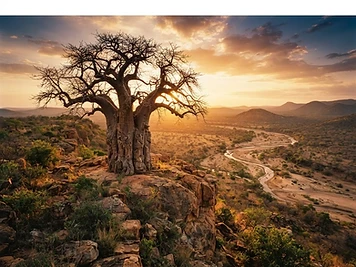
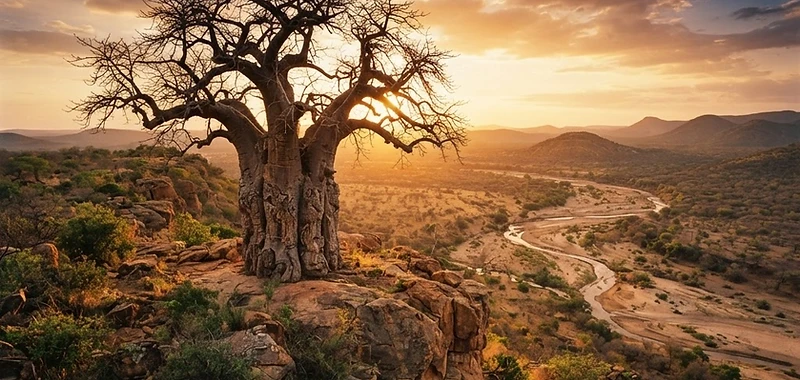
Mapungubwe National Park feels ancient and lonely in a way that the heavily manicured sections of Kruger never will. You arrive by driving north through flat, nondescript bushveld until the terrain suddenly fractures into dramatic sandstone outcrops and massive, twisted baobab trees that seem to loom over the road. The light here is particularly heavy, turning a burnt orange against the pale rock during the late afternoon. It does not feel like a typical managed park. It feels like a sprawling, rugged frontier where the borders of South Africa, Botswana, and Zimbabwe blur together at the confluence of the Limpopo and Shashe rivers.
The air is usually hot, dry, and thick with the smell of river silt and baking stone. The silence is the first thing you notice when you kill the engine. There is no background hum of tourist traffic here. You are effectively in the middle of a geological and historical crossroads. The landscape is dominated by riverine forests that provide a lush, dark contrast to the harsh, exposed sandstone ridges above. Unlike the neighbouring reserves which often feel like fenced game-viewing circuits, Mapungubwe presents itself as a vast, unforgiving, and deeply quiet expanse of lowveld.
Wildlife, realistically
You do not come to Mapungubwe for the sheer volume of animals you see in the private reserves of the Greater Kruger. The bush is often dense along the riverbanks, making the larger mammals notoriously difficult to track. You will see elephants here, and they are frequently seen moving in significant herds along the Limpopo floodplains, but they are wary and often keep their distance. Predators exist in the park, but they are not the reliable staples of a morning drive. Seeing a leopard or a lion is a matter of immense patience and a fair amount of luck rather than a guarantee.
Birding is the quiet highlight for those who bother to look up. The raptor population is substantial, and the riverine forest acts as a magnet for species that prefer the lush, water-rich corridors. You will see plenty of antelope, including kudu and impala, but they are skittish and lack the habituation seen in more tourist-saturated parks. Do not expect to tick off the entire checklist in a single weekend. The wildlife here is sparse, spread out over a large area, and requires you to work for every sighting by scanning the scrub or waiting for hours at the water points.
How a visit works
A visit to Mapungubwe requires a degree of self-sufficiency that many travellers underestimate. You are roughly three hours from the nearest major town of Makhado, so you must arrive with your vehicle fueled and your supplies stocked. The park logic is split between self-drive exploration along the network of gravel loops and mandatory guided excursions for the archaeological sites. If you try to do everything in one frantic day, you will fail. The scale of the park demands at least two or three nights to actually absorb the landscape and gain access to the hill where the gold rhino was discovered.
Your day will naturally shape itself around the heat. Early mornings are for driving the loops while the air is still cool, while the middle of the day is best spent retreating to the shade of the camp or the interpretive centre. The archaeological tours are the core of the experience, requiring you to book your spot at the gate upon arrival. If you do not plan your time around these guided slots, you miss the entire point of the park. It is not a place for quick drive-throughs; it is a place that rewards a slow, methodical pace.
When to go
Timing your trip to Mapungubwe is a trade-off between the unbearable heat and the availability of water. Mid-summer brings stifling temperatures that make being outside for any length of time a misery, though the landscape turns a vibrant, lush green that is stunning to photograph. Conversely, the cooler winter months make for much more comfortable days. During the dry season, the vegetation thins out, which makes spotting game significantly easier as the animals congregate near the shrinking river pools. The trade-off is a landscape that looks bleached, dusty, and skeletal.
Budget travellers should note that while the park does not suffer from the extreme price spikes of private concessions, the costs of getting here—fuel, supplies, and time—are high. Late autumn and early spring are the sweet spots. You get manageable temperatures and a better chance at wildlife sightings before the intense heat sets in. Avoid the school holidays if you crave the solitude that defines this park, as the limited accommodation can lead to a cramped feeling in the communal areas, which ruins the sense of isolation you travelled all this way to find.
Who it suits, who it does not
Mapungubwe suits the traveller who is bored by the theme-park atmosphere of the main Kruger gates. It is for those who value history as much as nature and who have the patience to sit at a waterhole for two hours without seeing a single head of game. If you are the type of person who needs a constant stream of big cats to feel like a trip was a success, you will find this park profoundly frustrating and ultimately dull. It is a place for the long-tail traveller who wants to feel small against a backdrop of deep time and rugged geography.
If you are on a tight itinerary, skip this place entirely. It is too far removed and requires too much logistical effort for a flying visit. You are better off heading to the northern reaches of the Kruger National Park or the nearby private reserves if your priority is solely high-density wildlife viewing. Mapungubwe is for the person who wants to stand on top of a sandstone cliff, look over a river into three different countries, and appreciate that they are a very long way from anywhere else.
What's here