
First-timer's case
Why South Africa is the smart way to meet Africa
If you've always wanted to go to Africa but keep putting it off, South Africa is where the excuses run out.
For a lot of Western travelers, Africa sits in the imagination as both the dream trip and the hard one — far, expensive, complicated, a little intimidating. South Africa is the country that quietly dismantles most of that.
It is not the whole continent, and it's not a substitute for the Serengeti migration or the pyramids. But it is the most forgiving, best-equipped place to take your first real bite of Africa — and to leave wanting more, rather than regretting you ever went.
Why South Africa, specifically
Six things that make it the easy on-ramp
You land and immediately function
English is the lingua franca, roads are good, cards work, and your phone roams. The logistics friction that defines harder African trips is largely absent here.
Direct flights, mild jet lag
Nonstop service from major US hubs to Johannesburg and Cape Town, with a time difference that won't wreck your first days on the ground.
Safari without the malaria question
The Eastern Cape reserves — Addo, Shamwari, Kariega — plus Madikwe and Pilanesberg are malaria-free. No pills, no nets. You can take kids or nervous travelers without a medical decision.
The strongest dollar value on the continent
The rand is weak against the US dollar. The same safari-and-wine-country trip costs a fraction of what it would in East Africa or at home.
You can drive yourself
A rental car and a map turn the whole country into a road trip — the Garden Route, the Winelands, the Drakensberg. No convoy, no guide required on the marquee routes.
Visa-free for US visitors
Americans get up to 90 days on arrival. No paperwork in advance, no embassy visit, no waiting.
The worries, handled
What first-timers ask us, answered straight
Is it safe?
The honest answer is block-by-block, not yes-or-no. Tourist routes are well-traveled and well-policed; you'll use the same urban judgment you'd use in any major city.
Read the safety guideWill I be able to communicate?
Yes. English is everywhere — signage, menus, guides, and nearly everyone you'll deal with.
Is the food and water okay?
Tap water is safe in the cities and on the main tourist routes. Cape Town's food scene is genuinely world-class.
Can I use my card?
Everywhere. Carry a little cash for tips and farm stalls, but you won't need much.
Do I need a guide?
For self-drive routes, no. For safari and the townships, yes — and it's a better trip that way.
What about malaria?
Avoidable entirely if you pick a malaria-free reserve. If you choose Kruger, talk to your doctor — the risk is low and seasonal.
If it's your first time
Do the trip most first-timers should do
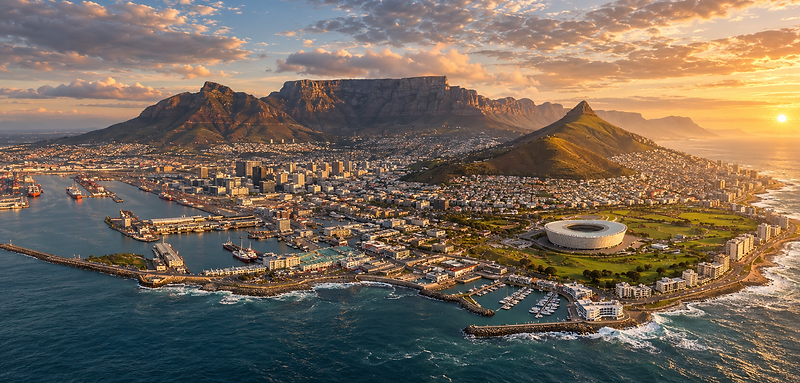
Cape Town for four or five days, two in the Winelands, three or four down the Garden Route, and two or three on a malaria-free safari. Two weeks, drivable, no internal flights — and you'll see the ocean, the mountains, the wine, and the big five without ever feeling out of your depth.
What this trip is, and what it isn't
This is an on-ramp, not the whole road. South Africa will not give you the remote, off-grid Africa of certain expectations. What it gives you is a confident, well-supported first experience — the kind that makes you want to go deeper next time, to Mozambique, to Botswana, to Tanzania. We think that's the right first trip to take.
Come for the big five and Table Mountain, stay for the farm stalls, the dirt roads, and the conversations you didn't expect. South Africa is the Africa you can actually do — and the one that tends to send people home already planning the next one.
Going to Africa for the first time?
Our first-timer itinerary and the field notes we wish we'd had.