Hluhluwe–iMfolozi Park
South Africa's oldest game reserve and the park that saved the white rhino.
Trip Role
Ideal stay
Best for
Our take
A vital conservation success story and a top-tier rhino viewing destination.
A vital conservation success story and a top-tier rhino viewing destination.
- Trip Role
- Day Trip
- Ideal Stay
- 1–2 nights
- Best For
- Self-drive, rhino, KZN combos
- Go If
- You're in KZN and want Big Five with a rhino focus.
Why it's worth your time
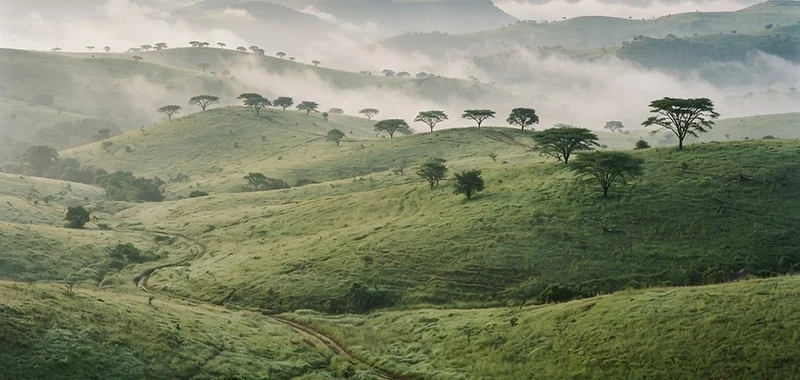
As the oldest game reserve in South Africa, this park is historically significant for its successful white rhino conservation efforts. The hilly terrain provides a distinct landscape compared to the flat savannahs of the northern parks.
What we love
The rhino — this park saved the southern white rhino from extinction.
What to know
The oldest proclaimed game reserve in Africa (1895); the cradle of southern white rhino conservation, from which the species was rescued.
The full guide
What it is like
Hluhluwe–iMfolozi is defined by its unrelenting topography. Unlike the flat, open expanses of the Lowveld, this landscape is a continuous sequence of steep ridges and deep valleys. The vegetation follows these contours, shifting from dense thicket in the ravines to open savannah on the crests. The light here has a specific quality that catches the sharp slopes, creating dramatic shadows that mask movement until a large animal steps into a clearing. It feels ancient and enclosed, a claustrophobic beauty that rewards patient observation rather than quick scanning.
The first hour inside the gates rarely delivers the instant spectacle found in larger, more commercial parks. You are immediately navigating narrow, winding roads that demand focus and low speeds. There is a perceptible heaviness to the bush, a sense of deep time rooted in its status as the oldest proclaimed game reserve in Africa. The sounds are more muted, filtered through the thick scrub, and the air feels dense with the proximity of animals you cannot quite see. It lacks the manicured ease of private reserves and demands an active, engaged style of exploration.
Wildlife, realistically
This is the sanctuary that saved the southern white rhino from the brink of total extinction. Consequently, you will see white rhino here with a frequency that borders on routine. They are the defining presence, frequently found grazing on the hillside slopes or resting near the water holes along the river systems. The park supports a healthy population of the Big Five, though your success depends entirely on your willingness to sit still and watch the shadows. Sightings are concentrated around the permanent water sources in the Mfolozi section, especially as the dry season progresses and water becomes scarce.
Leopards and cheetahs are present but notoriously elusive in the thick, broken terrain. Do not arrive expecting a high-octane predator show. The dense cover makes finding cats an exercise in extreme luck or immense patience. Lions are more visible, often patrolling the ridge lines or lounging in the shade of acacia trees. The sheer scale of the valleys means that for every animal you see, there are dozens hidden within a few hundred metres. Manage your expectations; this is a place for appreciating the conservation success of the rhino rather than ticking off a predator checklist.
How a visit works
The park operates on a system that favours self-drive exploration. You manage your own pace, driving the winding gravel and tar routes between the various camps. The logic of the park requires you to be self-sufficient, as infrastructure can be basic and varies significantly depending on where you choose to stay. A day is shaped by the topography; you will move slower than you expect, so plan your routes to avoid being stuck in transit when the gates close. There is no benefit in rushing from one end to the other, as the terrain dictates a steady, measured progress.
Two nights is the logical duration for most. A single night often leaves you feeling rushed, as the hilliness makes covering significant distance difficult within a short window. Staying for two nights allows you to settle into the rhythm of the valleys and explore different sectors of the reserve without burning your daylight behind the steering wheel. Guided game drives are available, though the experience varies widely depending on the individual ranger and the group dynamic. If you prefer to set your own schedule, self-drive remains the superior choice for deep engagement with the landscape.
When to go
Winter is the undisputed choice for visibility. From June through August, the bush thins out and the grasses die back, making it significantly easier to spot wildlife against the steep hillsides. The days are dry and mild, though the temperature drops sharply at night. Water is limited to central pans and the river, forcing animals into the open and predictable locations. The trade-off is the popularity of the park during these months, as the roads can feel congested with other vehicles, particularly during school holidays.
Summer brings lush, green scenery but turns the bush into a wall of impenetrable green. Game viewing becomes a difficult game of hide-and-seek, and the heat can be oppressive in the low-lying valleys. Fire risk is a real consideration during the dry late spring, which can turn the landscape into a charred, charcoal-dusted expanse. Avoid the busiest periods if you dislike sharing sightings, but accept that quiet times often coincide with the worst conditions for actually seeing the animals. It is a calculated compromise between personal space and wildlife visibility.
Who it suits, who it does not
This park rewards the patient traveller who values the history of conservation over the promise of high-density predator viewing. If you appreciate the significance of standing in the place that pulled the white rhino back from nothingness, you will find it deeply satisfying. It suits those who are comfortable behind the wheel and enjoy navigating challenging, hilly terrain without the need for constant hand-holding or luxury amenities. It is a place for quiet observation and slow-paced discovery, free from the synthetic polish of high-end, private lodge experiences.
It will frustrate the traveller who demands immediate gratification or expects the manicured, easily traversable savannahs found elsewhere in South Africa. If your primary goal is a prolific predator safari where guides do the heavy lifting, you will find the density of the bush and the difficulty of the terrain exasperating. In those cases, heading to a private reserve in the Lowveld is a more efficient use of your time and resources. Hluhluwe–iMfolozi is not a playground for casual tourists; it is a serious, hilly, and historically vital sanctuary that requires effort to truly unlock.
Pair it with

Ballito
A north-coast KZN resort town — sugar-cane coast, dolphin-watching beaches, and Durban's holiday escape.

Durban
South Africa's beach city — a warm Indian Ocean coast, the country's largest Indian community, and the gateway to KZN.

Kruger National Park
South Africa's flagship Big Five park — nearly two million hectares of lowveld, 147 mammal species, and one of the densest wildlife populations in Africa.