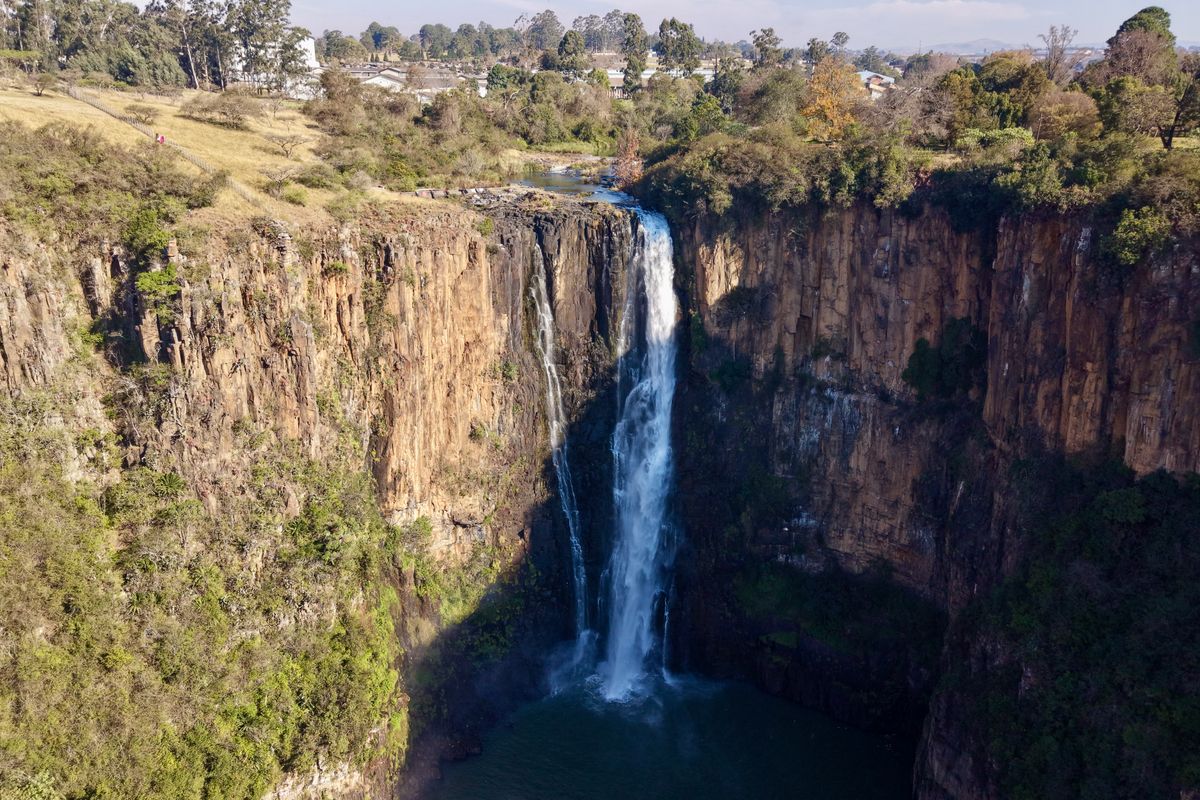
Tugela Falls
The world's second-highest waterfall, plunging off the Drakensberg escarpment at Royal Natal.
Trip Role
Ideal stay
Best for
Our take
Tugela Falls is a high-stakes mountain experience that rewards effort with immense scale. It is not a casual roadside attraction, but a serious hike that demands respect for weather, altitude, and the reality of seasonal flow.
Tugela Falls is a high-stakes mountain experience that rewards effort with immense scale. It is not a casual roadside attraction, but a serious hike that demands respect for weather, altitude, and the reality of seasonal flow.
- Trip Role
- Worth a Detour
- Ideal Stay
- Full day, 6 to 9 hours including the hike.
- Best For
- high-altitude hiking, dramatic escarpment views, mountain photography, physical challenge
- Skip If
- casual tourists, small children, those without high-clearance vehicles
- Go If
- You are a fit hiker who prioritises high-altitude mountain terrain and dramatic, sweeping vistas over easy access. You have the patience to wait for the right weather and the right season.
Why it's worth your time
Seen best from the bottom of the Tugela Gorge or, in a wet year, from the top via the chain ladders. It often dries to a whisper in winter; go after summer rains for the real thing.
What we love
The sheer scale of the Amphitheatre wall is unmatched in Southern Africa. Standing at the top of a nearly one-kilometre drop provides a perspective on the landscape that no valley-floor viewpoint can replicate. It is a raw, exposed environment that makes you feel small in the best possible way.
What to know
The waterfall is seasonal and often dries to a trickle in winter. Always check recent rainfall before committing to the hike. The access road to the Sentinel car park is notoriously rough and often requires a high-clearance vehicle. Fees, permit requirements, and gate procedures vary by operator and season, so confirm these details with the park or your lodge before you leave.
The full guide
Choosing your route
You have two distinct ways to experience the falls. The summit route from the Sentinel car park is the most popular, taking you to the top of the Amphitheatre via a series of chain ladders. This is a demanding day hike that puts you at the edge of the escarpment. If the ladders are a dealbreaker, the Kloof Gully route offers an alternative, though it is physically more strenuous and requires scrambling over boulders. Alternatively, the Tugela Gorge trail from within Royal Natal National Park offers a view from the bottom. This is a longer, flatter walk that focuses on the scale of the rock wall rather than the height of the drop. Both options require a full day and a high level of fitness.
Managing the conditions
The Drakensberg is a high-altitude environment where weather shifts with little warning. Afternoon thunderstorms are common in summer and can make the exposed plateau dangerous. If you are attempting the summit, start as early as possible to ensure you are off the high ground before the clouds roll in. Visibility is the primary variable; if the mountain is shrouded in mist, the hike loses its primary reward. Never attempt the summit route in poor visibility or if you are not comfortable with navigation. The terrain is unforgiving, and the paths can be difficult to follow if you are not experienced in mountain walking. Always carry adequate water, warm layers, and a headlamp, regardless of the forecast.
Practical logistics
Accessing the trailhead is often the most frustrating part of the day. The road to the Sentinel car park is rough and frequently requires a high-clearance vehicle; if you do not have one, you may need to arrange a shuttle from a local lodge. You will encounter various fees for park entry and hiking permits, which are typically payable in cash. These details vary depending on whether you enter through the main Royal Natal gate or the Sentinel access point. Sign the hiking register at the start and ensure you sign out upon your return. This is not a suggestion; it is a safety requirement. Check with the local visitor centre or your accommodation provider the day before to confirm current road conditions and permit requirements.
Before you book
Questions Tugela Falls always raises
- Is the hike to the top of Tugela Falls dangerous?
- It involves high-altitude terrain, steep cliffs, and vertical chain ladders. While the path is well-defined, it is not a walk in the park. If you have a serious fear of heights or are not physically prepared for a long, strenuous day, the risks are significant.
- Can I see the waterfall all year round?
- No. Tugela Falls is a seasonal waterfall. It relies on summer rainfall to maintain its flow. In the dry winter months, it often dries up completely. The best time to see it is after the summer rains, typically between March and May.
- Do I need a guide to hike to the top?
- A guide is not strictly required by law, but it is highly recommended if you are unfamiliar with the area or the weather patterns of the Drakensberg. The terrain is exposed and navigation can become difficult if the mist descends quickly.
- What kind of vehicle do I need to reach the trailhead?
- The road to the Sentinel car park is rough and poorly maintained. A high-clearance vehicle is strongly advised. If you are driving a standard sedan, you should arrange a shuttle service from a nearby lodge to avoid potential damage to your car.
More waterfall in KwaZulu-Natal

Howick Falls
A 95-metre waterfall in the centre of Howick, on the Midlands Meander route.

Karkloof Falls
A 105m falls in the KZN midlands — a forest walk, a picnic site, and the midlands' most accessible big drop.

Nandi Falls
A waterfall in the Cathedral Peak area of the central Drakensberg, a short walk from the Didima trailhead.