Potjiekos
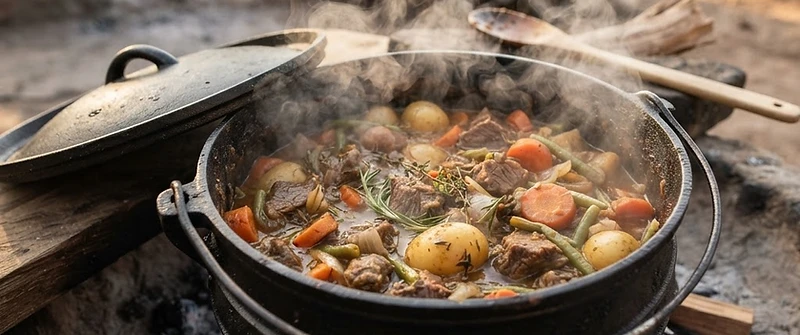
A cast-iron three-legged pot stew, slow-cooked over coals — meat and vegetables layered, never stirred.
Ideal stay
Best for
Our take
Potjiekos is a slow-cooked, communal ritual that rewards patience and discipline. It is not merely a stew, but a social event where the quality of the company matters as much as the tenderness of the meat.
Potjiekos is a slow-cooked, communal ritual that rewards patience and discipline. It is not merely a stew, but a social event where the quality of the company matters as much as the tenderness of the meat.
- Ideal Stay
- four to six hours, including the fire preparation
- Best For
- social gatherings, outdoor cooking, slow-paced afternoons, hearty comfort food
- Skip If
- impatient diners, formal restaurant settings, quick lunch seekers
- Go If
- You are travelling with a group that values long, unhurried afternoons outdoors. It suits those who enjoy the process of fire-tending and the slow, social build-up to a hearty, rustic meal.
Why it's worth your time
A Voortrekker dish — the three-legged cast-iron pot travelled with the Afrikaner pioneers and cooked over open coals. The method is the discipline: meat on the bottom, vegetables layered above, lid on, never stirred, so each layer keeps its own flavour. It's a braai-day event more than a restaurant dish — slow, social, and made for a crowd. Find it at a farm festival or cultural village, or get invited to one; it rarely translates to a menu.
What we love
The absolute refusal to stir the pot is what makes this dish superior to a standard stew. By layering ingredients and letting them steam in their own juices, each vegetable retains its distinct texture and flavour, preventing the mushy, uniform consistency that plagues most slow-cooked meals.
What to know
This is an outdoor event, not a menu item you order at a whim. It requires a three-legged cast-iron pot and a steady bed of coals. If you are not cooking it yourself, you must be invited to a gathering or find a farm festival where it is being prepared for a crowd.
The full guide
The Discipline of the Pot
The essence of potjiekos lies in the strict layering of ingredients. You start by searing meat at the bottom of the three-legged cast-iron pot, followed by layers of vegetables arranged by their required cooking time. Harder vegetables like potatoes and carrots go in first, while softer ones are added later. The most critical rule is that you never stir the contents. The heavy lid seals in the steam, allowing the ingredients to cook in their own juices without breaking down. This method ensures that the meat remains tender and the vegetables keep their shape and individual flavour. If you stir, you destroy the integrity of the dish, turning a carefully constructed meal into a uniform, overcooked stew. The fire management is equally vital, requiring a low, constant heat from coals rather than direct flames.
The Social Setting
Potjiekos is rarely a solitary pursuit or a quick restaurant order. It is a social anchor for weekends, camping trips, and farm gatherings. The cooking process is long, often taking several hours, which provides the perfect excuse for friends to gather around the fire with drinks. The host typically manages the coals and the timing, while guests provide conversation and, inevitably, unsolicited advice on the cooking. Because it is a communal dish, it is served straight from the pot, usually ladled over rice, pap, or accompanied by fresh bread to soak up the rich sauce. Being invited to a potjie is a sign of being welcomed into a local, unhurried way of life. It is food meant to be shared in the open air, where the atmosphere is as important as the meal.
Finding the Dish
Do not expect to find authentic potjiekos on a standard restaurant menu. It is a dish of the home, the farm, and the festival. If you are determined to try it, look for cultural villages, farm-stay events, or community gatherings where large-scale outdoor cooking is the focus. If you are staying at a hostel or a farm, ask the hosts if they have a potjie planned; they are often happy to include guests in the process. When you do encounter it, ensure it has been cooked over real wood or charcoal coals, as the smoky depth is impossible to replicate on a stove. If you are cooking it yourself, source your meat and root vegetables directly from local farms to ensure the best flavour. Always check with your host about the specific style, as recipes vary by region.
Before you book
Questions Potjiekos always raises
- Why is it called a three-legged pot?
- The three legs allow the pot to stand securely directly over a bed of hot coals. This design, which evolved from Dutch ovens, ensures the heat is distributed evenly beneath the base, which is essential for the slow, gentle simmering required for the meat and vegetables to cook properly.
- Can I make potjiekos on a stove?
- While you can technically cook the ingredients in a pot on a stove, you lose the essential wood-smoke flavour and the specific heat distribution of the coals. It ceases to be a traditional potjiekos and becomes a standard stovetop stew. The outdoor fire is a fundamental part of the experience.
- What should I serve with potjiekos?
- The dish is rich and saucy, so it is best served with something that can absorb the liquid. Traditional accompaniments include rice, pap, which is a thick maize porridge, or fresh, crusty bread. These sides act as a base for the meat and vegetables, ensuring no flavour is left behind.
- How do I know when the potjie is ready?
- The cooking time varies based on the ingredients, but it generally takes between three and six hours. You know it is ready when the meat is tender and falling off the bone and the vegetables are cooked through but still hold their shape. It is done when the time is up.