Pilanesberg National Park
Big Five park set in an ancient volcanic crater next to Sun City — malaria-free and one of the easiest self-drive safaris from Gauteng.
Trip Role
Ideal stay
Best for
Our take
The best short safari you can do from Johannesburg in two days.
The best short safari you can do from Johannesburg in two days.
- Trip Role
- Trip Anchor
- Ideal Stay
- 1-2 nights
- Best For
- Joburg-based short trips, malaria-cautious travelers, families.
- Skip If
- Travelers wanting vast wilderness or dense sightings.
- Go If
- You have two days and you're in Joburg.
What to optimise for
What Pilanesberg National Park rewards
The same reserve can be a different trip depending on what you came for. Choose the version you want, then plan around it.
- Short Joburg Getaway
- This park serves the Johannesburg market perfectly for a quick safari fix. Use your two days to hit the main loops early, as the park is compact enough to navigate efficiently. The compromise is the high traffic from other day visitors, so prepare for crowded sightings during peak hours.
- Malaria-Free Safari
- If you want to avoid prophylactic medication, this is your primary choice near the city. The entire park remains free of malaria risk year-round, which simplifies family planning significantly. The compromise is a smaller geographical scale compared to the lowveld reserves, meaning you will see the same terrain repeatedly.
- Family Sightseeing Trips
- The park is manageable for younger travellers who might struggle with long hours in the car elsewhere. The proximity to resort facilities provides a safety net for meals and entertainment. The compromise is the potential for vehicle congestion at lion or leopard sightings when the park gates are busy.
- Volcanic Landscape Photography
- The circular geological formations provide a backdrop that differs from the typical flat savanna of other reserves. Focus your photography on the dramatic ringed hills during the golden hours. The compromise is that the scrubby vegetation can be dense, which occasionally obscures subjects compared to more open plains.
When to go
Timing a visit to Pilanesberg National Park
Rain, grass and water decide what you see. These are the trade-offs, season by season.
May to September (Dry Winter)
BestThis is the most reliable time to visit. The grass dies back, making it far easier to spot big game as they congregate near permanent water holes. Mornings are cold and require warm layers, but the visibility is high. It is the best period for serious wildlife photographers.
November to March (Green Season)
MixedSummer brings heavy afternoon thunderstorms and intense heat. The bush becomes thick, hiding predators effectively and making game viewing a challenge. While it is excellent for birding and seeing new calves, you must be prepared to drive longer to find animals. The park is quieter during these months.
April and October (Shoulders)
GoodThese months offer a balance between the extremes of heat and cold. The vegetation is transitioning, offering decent visibility without the biting winter chill. You get moderate crowds and more comfortable temperatures for self-drive tours. It is an ideal compromise if you want to avoid the peak winter rush.
How long to stay
Nights, and what each one buys
Nights are the unit of cost here. This is the honest return on each one.
- Day visit
- This is entirely feasible given the proximity to Johannesburg. You can enter at sunrise, spend a full day on the internal loops, and exit by sunset. It is exhausting but productive for those on a tight schedule who only need one solid day of game viewing.
- Two to three nights
- This is the optimal duration for most visitors. It allows enough time to explore the eastern and western sectors without rushing. You can dedicate mornings and afternoons to driving while using the midday heat to rest at your lodge. Anything longer may start to feel repetitive here.
- A week
- A full week is generally too long for this park. The scale is limited, and you will eventually find yourself driving the same roads repeatedly. If you have seven days, you should look at larger concessions in the lowveld where the ecological variety is far greater.
Getting there
Airport, road, gate
Distances here are hours, not kilometres. Fuel up before the last town.
- Nearest airport
- OR Tambo International in Johannesburg is the standard entry point for most travellers. While Sun City has a small airfield for private charters, the vast majority of visitors drive the two-hour route from Johannesburg or Pretoria directly to the park gates.
- Drive
- The drive from Johannesburg takes approximately two to two and a half hours, depending on traffic leaving the city. The route is straightforward and paved until you reach the park perimeter, making it a very accessible destination for a weekend trip.
- Gates and hours
- The gates operate on strictly seasonal hours which align with sunrise and sunset. You must plan your arrival to ensure you are inside before the gates close, or you will be barred from entry. Always check the current schedule as these times change slightly with the seasons.
- Roads and vehicle
- A standard sedan is perfectly adequate for the internal park roads. While some sections are gravel, they are generally well-maintained and navigable for any passenger vehicle. You do not need a 4x4 or high-clearance vehicle unless you plan on driving extensively on secondary tracks.
Where to base yourself
Three kinds of base
The base decides your gate times, your privacy and your bill more than the reserve does.
Public Rest Camps
These are government-run and provide the most budget-friendly way to stay inside the park. You get basic accommodation and immediate access to the early morning gates. Facilities are functional but stripped of luxury, making them purely about the location and the wildlife.
Private Concessions
Staying in a private lodge inside the park offers a higher level of comfort and exclusive game drives. You get access to areas restricted to public vehicles. It is significantly more expensive, but it removes the stress of navigating the busy public roads yourself.
Sun City Gateway
This is for those who prefer hotel infrastructure over rustic bush living. You stay in the resort and drive into the park for the day. It provides a massive variety of dining and entertainment options, but it lacks the immersion of staying inside.
Day trips and detours
What else the day holds
Most stays run on a fixed rhythm of dawn and dusk drives. The middle of the day is yours.
Sun City Resort
Adjacent to the park
This is less of a trip and more of a base extension. If you want resort amenities, casinos, or swimming pools, this is where you go. It contrasts sharply with the wild park environment, providing a necessary escape for those who get bored quickly.
Heritage Sites
Within an hour
There are local sites detailing the history of the crater and the surrounding Bafokeng lands. These are worth a visit if you are staying for more than three days and need a break from the vehicle. Otherwise, skip them to maximize your time viewing game.
Bakubung Bush Lodge
Within the park
While located inside, visiting for a meal or a guided activity is possible. It offers a different perspective and higher service levels than the public rest camps. It is a good way to see how the private concession side of the park operates.
What it costs
The money, in bands
Rand rates and park fees change. Compare the bands, then check current figures with the park or the lodge directly.
- Park or reserve fees
- Entry fees are charged per person and per vehicle. These are standard government rates that fluctuate annually. You should check the official park website before you depart to confirm the exact current rates and ensure you have the correct cash or card payment ready.
- Self-catering
- This is the most economical choice. By staying in the public rest camps and preparing your own food, you keep daily costs quite low. Rates for these units vary depending on the season, so verify pricing directly with the park reservation office before booking your dates.
- Mid-range guided
- Booking a safari through an established tour operator provides a guided experience without the top-tier luxury price tag. You pay for the convenience of an expert driver and comfortable mid-range lodge accommodation. Prices vary significantly based on the provider and the specific time of year chosen.
- Top end and fly-in
- For a premium experience, private lodges inside the park provide all-inclusive rates that cover food, drinks, and daily game drives. These are expensive, reflecting the level of service and exclusivity. Rates vary wildly by lodge, so confirm your quote with the specific operator well in advance.
Why it's worth your time
Pilanesberg sits in the crater of an extinct volcano two hours from Johannesburg, malaria-free, and it's the park most Joburg travelers use for a quick Big Five fix. The geology is striking — ringed hills around grassland — and the game is all there: lion, elephant, rhino, buffalo, leopard, plus cheetah and wild dog. It's small enough to self-drive in a day and sits next to Sun City, so you can pair a lodge stay with resort facilities. The trade-off is density and scale: it's a fraction of Kruger's size, sightings can be thin on a hot afternoon, and it gets busy with day visitors. But for a two-day safari from Joburg without malaria risk, there's nothing closer or better.
What we love
Big Five in a volcanic crater two hours from Joburg, no malaria.
What to know
Malaria-free. Self-drive or guided. Pairs with Sun City. Day visitors can crowd the gates.
The full guide
What it is like
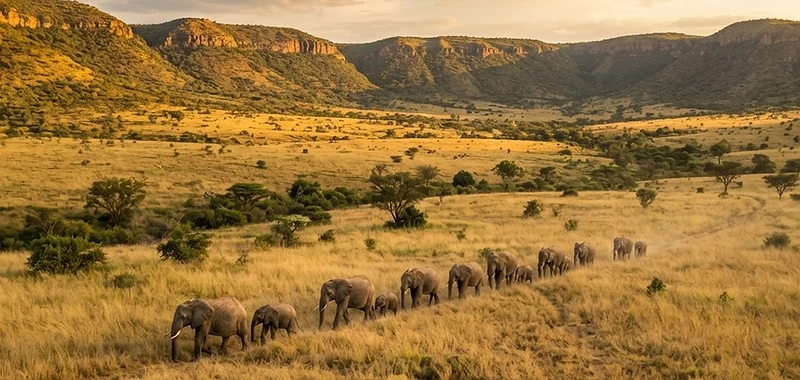
Pilanesberg sits inside the crater of an extinct volcano. The topography is defined by concentric rings of rugged hills that enclose vast, undulating plains of scrub and grassland. The geology dictates the experience. You drive through narrow mountain passes that suddenly open into sweeping savannah basins. Because the park is compact, the scale feels intimate compared to the sprawling wilderness areas of the Lowveld. The light catches the red rocks of the volcanic ridges in the late afternoon, creating sharp contrasts that photographers appreciate. The ambient sound is a mix of distant engine noise near the main arterial routes and the persistent rustle of wind through dry acacia scrub.
The first hour involves a sharp transition from the manic energy of the nearby resort complexes to the relative silence of the bush. You notice the density of the habitat immediately. Vegetation is thick in the valleys, forcing you to scan the breaks in the trees rather than looking across infinite horizons. It lacks the wild, untamed silence of larger reserves because the borders are close and human infrastructure is always nearby. It is a managed, contained environment where the transition between civilization and the bush happens with abrupt speed.
Wildlife, realistically
The Big Five are present and accounted for, but spotting them requires patience and a bit of luck. You will likely see elephant and buffalo, as they are prolific and often graze near the road network. Rhinoceros inhabit the thicker bush, though they are notoriously elusive during the heat of the day. Lion and leopard are the residents most visitors seek, yet they remain masters of camouflage within the volcanic ridges. Expect to spend hours scanning granite outcrops and dense thickets. Cheetah and wild dog are occasionally sighted, though they move through large territories and do not hold to set schedules.
Sightings concentrate near the waterholes during the dry winter months when animals have fewer options for hydration. During the summer, the bush is lush and green, which makes the animals harder to find. Do not expect the constant, high-frequency encounters of a private reserve. The wildlife density is high for a park of this size, but the animals are not tethered to the roads. You must be prepared for long, quiet drives that yield nothing but scenery, punctuated by moments of intense, concentrated action when a predator is finally spotted by the community of vehicles on the road.
How a visit works
The park is designed for the self-drive traveller. A network of tarred and gravel roads makes the entire interior accessible in a standard vehicle. You navigate by map, stopping at designated hides and viewpoints that offer the best chance to sit and wait for movement. Guided game drives are available through various operators, but the experience changes significantly depending on the driver and the size of the safari vehicle. Self-driving offers the freedom to choose your own pace, though you are at the mercy of your own ability to spot game in the dense scrub.
Two nights is the logical duration for a visit. One night is too frantic, forcing you to rush between gates and activities, while three or four nights may leave you feeling confined by the park's limited size. The gates function as the heartbeat of the park. Day visitors arrive in waves, particularly on weekends, which leads to heavy traffic congestion at popular sightings. If you stay inside the park overnight, you gain the distinct advantage of being on the road during the quiet early morning and late afternoon hours before the day-tripper traffic peaks.
When to go
Winter is the superior season for game viewing. From May through August, the vegetation dies back and the water sources dry up, forcing the animals to congregate in the open. The weather is cool and crisp, which makes sitting in a car for hours far more pleasant than in the stifling heat of summer. The trade-off is the popularity of the park during these months, as clear skies and the lack of malaria risk draw large crowds of local families and tourists alike. Expect crowded viewing points and a high volume of vehicles on the primary routes.
Summer brings intense heat and frequent thunderstorms. The landscape turns a lush, deep green, which provides excellent cover for predators to hide. You will encounter fewer vehicles, but you will also struggle to see animals in the dense foliage. Dust is replaced by mud on the tracks, and the humidity can be exhausting. If your priority is seeing game, choose the winter months. If your priority is solitude and you are willing to accept the likelihood of seeing less wildlife, the shoulder seasons or even the summer months offer a quieter experience at a lower cost.
Who it suits, who it does not
Pilanesberg is the ideal destination for the traveller based in Johannesburg who needs a rapid escape from the city. It excels for those who are cautious about malaria and want a straightforward, accessible, and contained safari experience. Families benefit from the well-maintained roads and the proximity to the amenities at Sun City, which provide a reliable backup plan if the kids grow restless. It is a highly efficient machine for checking the boxes of a Big Five safari without the complexity or time investment of a long-haul trip to the northern provinces.
It frustrates the traveller who is looking for a sense of isolation or true wilderness. If you measure a safari by how long you can go without seeing another vehicle, this park will leave you deeply unsatisfied. It is far too small and popular to offer the expansive, raw feeling of the greater Kruger area. If you have more than a few days to spare and desire a remote, quiet encounter with nature, skip this destination entirely. Go to the lowveld instead, where the scale of the landscape and the diversity of the habitat provide the genuine experience that a small, volcanic crater simply cannot match.
Before you book
Questions Pilanesberg National Park always raises
- Is there a malaria risk here?
- No, Pilanesberg is a completely malaria-free destination. You do not need to take any prophylactic medication to visit this park, which makes it a frequent choice for families with young children or travellers who are medically sensitive to anti-malarial drugs.
- Should I self-drive or book a guide?
- Self-driving is easy and the preferred method for most, as the roads are well-marked and navigable. However, a guide provides deeper insight and saves you from the effort of spotting game yourself. Book a guide if you want to focus entirely on photography or relaxing.
- Do I need a 4x4 vehicle?
- No, a standard sedan is perfectly capable of handling all the main roads and internal routes within the park. The road network is well-maintained for general tourism, so you do not need the extra clearance or capability that a 4x4 provides.
- Are children allowed at the park?
- Yes, children are welcome and the park is a popular family destination. Most lodges and facilities are equipped to handle kids. Just keep in mind that they must remain in the vehicle during game drives, so ensure they are comfortable with spending time sitting still.
- Is it worth the money compared to Kruger?
- It depends on your time. If you only have a weekend, Pilanesberg is far superior because you save days of travel time. If you have a week or more, Kruger offers more depth and scale. Pilanesberg is about convenience and quick access, not long-term immersion.
Pair it with