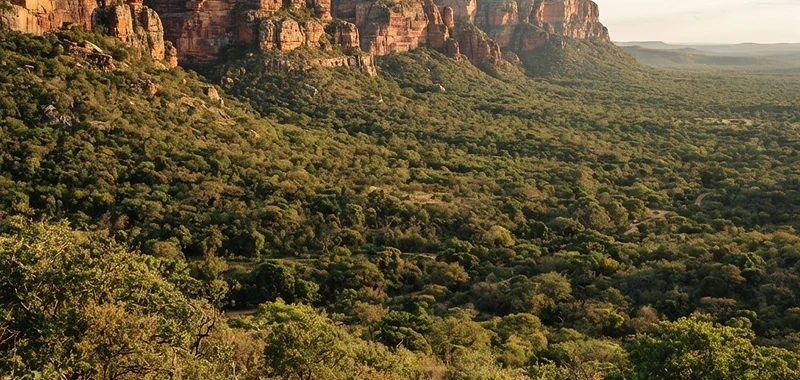
Marakele National Park
A malaria-free Big Five park in the Waterberg mountains, famous for the country's largest Cape vulture colony.
Trip Role
Ideal stay
Best for
Our take
The Waterberg's quiet, scenic Big Five park — and the best place to see vultures.
The Waterberg's quiet, scenic Big Five park — and the best place to see vultures.
- Trip Role
- Worth a Detour
- Ideal Stay
- 1-2 days
- Best For
- Scenery, vultures, and a quieter malaria-free safari
- Go If
- You want Big Five and birds of prey, malaria-free, away from crowds.
Why it's worth your time
Marakele sits in the Waterberg — malaria-free bushveld with mountains, and one of the world's largest Cape vulture colonies roosting on its cliffs. Quiet, scenic, and uncrowded.
What we love
The cliff drive to the vulture colony, with the whole Waterberg spread below.
What to know
Malaria-free; the Waterberg is a UNESCO biosphere reserve, and Marakele holds the country's largest breeding colony of Cape vultures.
The full guide
What it is like
Marakele is defined by the sheer verticality of the Waterberg mountains. The terrain is a sudden shift from the flat bushveld that dominates much of the surrounding Limpopo province. You enter the park and find yourself navigating narrow, winding roads that snake up toward high cliff edges. The light here is distinct, often catching the crags of the mountain face in a way that flattens the depth of the valley below, while the air feels significantly cooler than the low-lying plains. The soundscape is dominated by the rush of wind across high ridges and the heavy beating of wings.
It feels intimate and tucked away. Unlike the vast, rolling savanna of Kruger or the manicured, high-density environments of the private reserves near Hoedspruit, Marakele feels like a hidden corner. There is a sense of isolation that comes from the imposing geography. The vegetation is thick and scrubby, clinging to rocky slopes, which makes the park feel enclosed rather than wide open. You spend your first hour constantly checking your mirrors, not for other vehicles, but because the landscape is so rugged that every turn presents a potential vertical drop or a dramatic, sudden vista.
Wildlife, realistically
Expect a slower pace of viewing compared to the high-traffic reserves. You will see the Big Five here, but they are spread across a challenging, broken landscape. The density of animals is lower, meaning you might spend hours traversing scrubby thickets without a major sighting. The elephant herds move through the lower valleys, and you will encounter them, but do not expect the constant, predictable parades of animals found in the more famous parks. Sightings are earned through patience and luck, especially with predators like leopards that vanish into the dense mountain foliage.
The real highlight is the Cape vulture colony. This is one of the world's largest breeding populations, and they are the undisputed masters of the park. You will see them circling the peaks in high numbers, their silhouettes sharp against the blue sky. While mammals provide the standard safari experience, the sheer presence of these birds changes the character of the wildlife viewing. If you are specifically chasing a high-frequency parade of lions, you will be disappointed. The game is here, but the park demands that you accept the mountains themselves as the main attraction.
How a visit works
The park operates primarily as a self-drive destination, though various operators offer guided game drives that vary in quality and focus. The gate and camp logic is straightforward, focusing on a few select sites that anchor the experience. You spend your day navigating the main arterial roads and the more challenging tracks that lead up toward the mountain viewpoints. The roads are navigable for standard vehicles, but the terrain dictates a slow pace. You do not rush through Marakele; you crawl through it, and the geography naturally dictates the rhythm of your day.
Two days is sufficient to see the essential corners of the park. Anything longer risks monotony if you are solely focused on driving, as the loopable roads are limited. If you treat the trip as a detour within a larger Waterberg itinerary, one night allows you to hit the vulture cliff drive during the golden hour and take a morning drive through the plains. The infrastructure is designed to keep you moving along set routes, so you should plan your arrival to coincide with the cooler hours when the animals are most likely to emerge from the dense brush.
When to go
The seasonal trade-offs are significant. During the summer, the landscape is lush and green, but the heat can be punishing, and the thick vegetation makes spotting wildlife difficult. Fire is a constant reality in the dry seasons, as the scrubby, rocky terrain dries out quickly, leading to controlled or accidental burns that can temporarily close certain areas. The winter months are generally preferable for visibility, as the grass dies back and water becomes scarce, forcing animals to congregate around remaining sources.
Crowds are rarely a concern in this part of the world, regardless of the season. You will pay for the clarity of winter viewing with colder mornings and evenings, requiring decent gear. Cost remains relatively stable throughout the year, but accommodation fills up quickly during local school holidays. If you prioritize seeing the vultures and the broader landscape, the dry season wins every time. You lose the vibrant colours of the wet season, but you gain the ability to spot movement on the slopes that would be completely hidden by mid-summer foliage.
Who it suits, who it does not
This park rewards the patient traveller who prefers solitude over the checklist-ticking frenzy of more commercial reserves. If you appreciate the aesthetic of dramatic mountain geology and have an interest in raptors, you will find it deeply satisfying. It is also an excellent option for families who want a malaria-free environment without the rigid, expensive structure of a private game lodge. It suits the independent driver who enjoys navigating rugged, scenic routes at their own pace without constant interference from other tourists.
It will frustrate those who expect high-density predator viewing. If you are a first-time visitor expecting to see the Big Five within your first three hours, you will leave feeling that the park is empty or dull. For those who prioritize raw volume of game, the private reserves in the Greater Kruger area are the better alternative. Marakele is not a place for the impatient or those seeking luxury creature comforts. It is for the person who is happy to drive all morning, see only a few antelopes, and consider the day a success because the view from the cliff edge was worth the trouble.