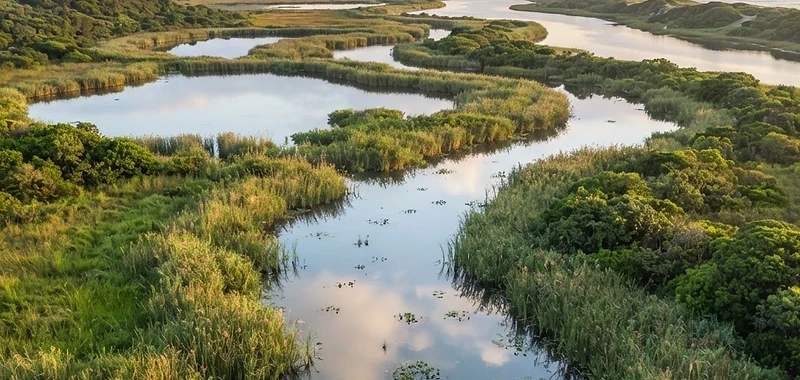
iSimangaliso Wetland Park
UNESCO World Heritage wetland of lakes, forests and dunes — hippos, crocodiles, turtles nesting, and whale sharks off the coast.
Trip Role
Ideal stay
Best for
Our take
A wetland wilderness, not a game-drive park — and unlike anywhere else in the country.
A wetland wilderness, not a game-drive park — and unlike anywhere else in the country.
- Trip Role
- Trip Anchor
- Ideal Stay
- 2-3 nights
- Best For
- Wildlife lovers who want more than Big Five, birders, families.
- Skip If
- Travelers who only want a classic game-drive safari.
- Go If
- You want a different kind of wildlife — water, forest, coast, not just savannah.
What to optimise for
What iSimangaliso Wetland Park rewards
The same reserve can be a different trip depending on what you came for. Choose the version you want, then plan around it.
- Water based wildlife
- Focus your time on the St Lucia estuary and Lake St Lucia. Boat cruises offer the best way to see hippos and crocodiles at close range. The compromise is that you spend less time scanning the bush for elusive terrestrial predators like leopard or lion which prefer the inland sections.
- Coastal nature photography
- Target the coastal dunes and beaches for unique lighting and marine life. You gain incredible shots of nesting turtles or breaching whales but sacrifice the classic savanna backdrop. Equipment must be protected from salt spray and humidity which requires more effort to manage than typical inland safari gear.
- Family nature trips
- Stick to the St Lucia gateway for ease of access to shops and guided activities. The park provides excellent educational value through boat trips and beach excursions. You lose the true wilderness isolation found in private concessions but gain the safety and convenience of a functional tourist town.
- Serious birding enthusiasts
- Navigate between the varied habitats of forest, swamp, and grassland to maximize species counts. The park hosts an enormous variety of waterbirds and raptors. The cost of this focus is significant travel time between the geographically separated sections of the park which forces long days on the road.
When to go
Timing a visit to iSimangaliso Wetland Park
Rain, grass and water decide what you see. These are the trade-offs, season by season.
May to September, Dry Winter
BestThe weather is cooler and lower rainfall reduces the risk of malaria significantly. Migrating humpback whales appear offshore during these months. Grass cover thins out making it easier to spot game in the uMkhuze section, although coastal forest remains dense. Expect busy periods during school holidays and higher rates.
November to February, Green Season
GoodThe bush is lush and full of newborn animals. This is the prime time for leatherback and loggerhead turtle nesting on the beaches. Expect high heat, humidity, and afternoon thunderstorms. Malaria risk is elevated so consult a doctor for prophylaxis. Tourist numbers drop and accommodation rates are lower.
March to April, Shoulder Season
BestThis period offers a balance of manageable temperatures and lingering greenery. The rains begin to taper off, making driving internal roads more reliable. It is an excellent time for birdwatching before the full winter migration takes effect. Prices start to stabilize between the low and high season peaks.
How long to stay
Nights, and what each one buys
Nights are the unit of cost here. This is the honest return on each one.
- Day visit
- A day visit allows for a brief boat cruise or a quick drive to the beach. You will miss the vast majority of the park. It is only worth it if you are already staying in a neighbouring private reserve and want a coastal change of scenery.
- Two to three nights
- This is the ideal duration to sample the different habitats. You have enough time for one major activity like a boat cruise plus a full day exploring the uMkhuze section. It provides a proper introduction to the wetland without the exhaustion of constant driving between sectors.
- A week
- A week allows you to explore the distant sections like Sodwana Bay or Kosi Bay. You avoid the rush and can wait for better weather for marine activities. Unless you are a dedicated angler or specialist birder, the travel distances between these remote areas can become tedious.
Getting there
Airport, road, gate
Distances here are hours, not kilometres. Fuel up before the last town.
- Nearest airport
- King Shaka International Airport in Durban is the primary gateway. It is roughly three hours of driving to the town of St Lucia. You will need to rent a vehicle at the airport as there is no reliable public transport available to reach the park entrance.
- Drive
- Driving from Johannesburg takes roughly eight hours on major national routes. The final stretch on provincial roads requires caution regarding potholes and local traffic. It is a long haul and best broken up with an overnight stop if you are travelling with children or driving alone.
- Gates and hours
- Park gates operate on strict seasonal schedules. Arriving after sunset is generally not permitted for safety reasons. Plan your day to exit by closing time as internal roads are not lit and navigation can be difficult after dark. Always check the specific gate times before departure.
- Roads and vehicle
- A standard sedan handles most main roads near St Lucia town and the main beach accesses. If you intend to explore the remote northern sections or uMkhuze's deeper tracks, a high-clearance vehicle is essential. Some sandy tracks are impassable during the rainy season for regular cars.
Where to base yourself
Three kinds of base
The base decides your gate times, your privacy and your bill more than the reserve does.
St Lucia Town
This is the most practical base. You have immediate access to restaurants, fuel, and tour operators. It keeps you close to the estuary boat tours. You sacrifice total seclusion but gain the convenience of being able to walk to dinner after a long day outside.
Inside the park
Staying at one of the few managed campsites or lodges inside the park boundaries provides immersion in the wilderness. You are closer to the animal activity. The trade-off is a lack of nearby amenities and the requirement to be fully self-sufficient regarding food and supplies.
Private concessions
These lodges offer high levels of service and curated safari experiences. They remove the stress of navigating park gates and planning routes. It is the most expensive option and usually removes you from the public town experience, offering a more exclusive but contained view of the park.
Day trips and detours
What else the day holds
Most stays run on a fixed rhythm of dawn and dusk drives. The middle of the day is yours.
uMkhuze Game Reserve
Two hours from St Lucia
This section offers the best chance for viewing larger terrestrial mammals in more traditional bushveld. It is well worth the drive if you find the coastal wetlands too humid or quiet. Do not go expecting the same density of animals as the nearby Hluhluwe-iMfolozi.
Cape Vidal
Forty minutes from St Lucia
A popular coastal destination for snorkelling and swimming. The road there often yields sightings of reedbuck or monkeys. It earns the time for those seeking a beach day, but it can get crowded. Skip it if you are looking for a secluded wilderness experience.
Hluhluwe-iMfolozi Park
One hour from St Lucia
Though technically a separate entity, it is the standard day trip for visitors wanting to see big game. It is a must-do if your primary goal is seeing rhinos. If you are specifically interested in wetland ecosystems, you might find it redundant to your itinerary.
What it costs
The money, in bands
Rand rates and park fees change. Compare the bands, then check current figures with the park or the lodge directly.
- Park or reserve fees
- You pay daily conservation levies upon entry. Rates vary based on your residency status and the specific gate used. Check the current fee structure on the official iSimangaliso website before you travel. These funds are essential for ongoing conservation efforts within the World Heritage site.
- Self-catering
- Self-catering remains the most affordable way to visit. Supermarkets in St Lucia allow you to stock up on supplies. Costs vary depending on your choice of chalet or campsite. You must factor in fuel costs for the extensive driving required to see the different park sections.
- Mid-range guided
- This budget includes organised boat tours, guided turtle walks, or game drives. Rates vary by operator and seasonal demand. It is worth the spend for guided expertise, especially when tracking elusive animals or navigating safe snorkelling spots where local knowledge provides a much better day.
- Top end and fly-in
- Luxury packages include fly-in transfers from major hubs and stays in private lodges. You pay for exclusivity and total logistical management. Rates vary wildly based on the level of luxury. This is for travellers who want a frictionless experience without any self-drive requirements or planning stress.
Why it's worth your time
iSimangaliso is the park that breaks the safari template. A UNESCO World Heritage Site on the KZN north coast, it's a mosaic of lakes, estuaries, coastal forest and dune beaches rather than open savannah, and the wildlife reflects that: hippos and crocodiles in the St Lucia estuary, turtles nesting on the beaches in summer, whales offshore in winter, and big game in the uMkhuze section. You don't come here to tick off the Big Five from a vehicle — you come for a boat cruise past hippos at sunset, a turtle-nesting walk in November, and a stretch of coast that still feels wild. It pairs naturally with a Hluhluwe-iMfolozi stop inland. Malaria is a low-but-real consideration in summer.
What we love
Sunset on the St Lucia estuary with hippos grazing the banks.
What to know
Malaria zone in summer. Several separate sections; St Lucia town is the easy base. Book turtle tours in season.
The full guide
What it is like
iSimangaliso feels humid, dense, and tangled compared to the arid scrub of more traditional bushveld destinations. The scale of the park is massive, stretching over many kilometres of coastline, and the transition from saltwater estuary to thick coastal dune forest happens within minutes. The light here is heavy and diffused by the moisture in the air, creating a soft, hazy atmosphere that differs sharply from the stark, high-contrast sun of the interior. The soundscape is dominated by water, wind in the trees, and the constant hum of insects rather than the distant roar of lions or the crunch of dry grass.
Driving through the gates, the first hour feels like a transition into a swampy, sub-tropical wild. You are not greeted by wide-open savannah plains where animals stand out against the horizon. Instead, you are looking through layers of vegetation and navigating around expansive lake systems. The park occupies a unique ecological niche, making it feel more like a series of interconnected, isolated habitats than a single continuous game reserve. It is a slow, methodical environment that rewards patience over speed.
Wildlife, realistically
Do not come here expecting a guaranteed checklist of savannah predators. While the uMkhuze section offers a better chance at the traditional big game species, the park is defined by its water-bound wildlife. You will see hippos in the St Lucia estuary almost certainly, and crocodile sightings are predictable, particularly along the banks of the lakes. Birders will find the park overwhelming, as the variety of habitats supports an incredible density of species that simply do not exist in the drier reserves inland.
Finding leopards or elephants requires significant luck and the right section of the park. These animals are often elusive because the dense cover provides them with endless places to hide. The marine life is the true star here. In summer, nesting sea turtles become the main event on the beaches, while winter brings the predictable movement of whales offshore. The wildlife here is seasonal and geographically fragmented, meaning you must be willing to shift your focus from land mammals to the aquatic and avian populations to get the most out of your time.
How a visit works
The park is divided into several distinct sections, and moving between them takes time. St Lucia town is the primary base for most visitors, providing easy access to the estuary and the southern beaches. Self-driving is the most common way to experience the park, allowing you to move at your own pace, though the roads can be slow and sandy depending on the recent weather. You should allocate at least two or three nights to do the area justice, as trying to pack the park into a single day results in little more than time spent behind the wheel.
Guided boat cruises are an essential component of the visit, offering a perspective on the estuary that you cannot get from a car. Your daily schedule will be shaped by the tides and the specific activities you book, such as turtle tours or marine excursions. The park does not follow the standard safari logic of morning and evening game drives alone. Instead, your day will likely be a mix of forest drives, beach walks, and water-based activities that require careful planning in advance.
When to go
The timing of your visit dictates your experience entirely. Summer is the time for turtle nesting, but it brings intense heat and humidity, along with a genuine, if low, risk of malaria. The vegetation is at its thickest, making game viewing on land increasingly difficult. If you visit in these months, expect to be drenched in sweat and fighting off insects for much of the day. The crowds can also be significant during local school holidays, driving up prices and filling the limited accommodation options quickly.
Winter is significantly more comfortable, with drier conditions and thinner bush that improves your chances of seeing elusive land animals. The temperature is milder, though the sea can be rough and the water-based activities might be less pleasant for those who dislike a chill. You trade the unique nesting phenomena of summer for a more manageable climate and better inland visibility. Choose between the aquatic intensity of summer or the logistical ease of winter; you cannot have both.
Who it suits, who it does not
This park rewards the curious traveller who finds a savannah landscape monotonous. It suits those who appreciate the intricacies of ecosystems—the transition of flora, the rhythm of the tides, and the life cycles of marine animals. If you have a specific interest in birds, reptiles, or aquatic mammals, this is the premier destination in the country. It is a place for people who want to be active in nature rather than merely observing it from a vehicle seat.
It is the wrong choice for the traveller whose primary goal is a classic Big Five safari. If your measure of success is a high count of lions or rhinos seen in a single weekend, you will find iSimangaliso frustrating and disjointed. You are better off heading directly to a dedicated game reserve like Hluhluwe-iMfolozi inland. That park provides the concentrated, predictable wildlife experience that people often wrongly expect when they arrive at the gates of a wetland reserve. Do not force yourself into this landscape if you are only chasing terrestrial predators.
Before you book
Questions iSimangaliso Wetland Park always raises
- Is there a malaria risk?
- Yes, there is a risk, particularly in the summer months. You should consult a medical professional regarding prophylaxis well before your trip. While the risk is generally considered low, it is not zero and you should always take precautions like using repellent and wearing long sleeves at night.
- Should I self-drive or hire a guide?
- Self-driving is fine for the main roads and gives you freedom, but a guide is superior for finding wildlife. Guides know the current animal movements and can navigate the more difficult tracks. If you are serious about seeing game, pay for at least one guided drive.
- Do I need a 4x4?
- A 4x4 is not mandatory for the main tourist routes but it is highly recommended if you plan to explore the northern sections of the park or beach access tracks. Many of the internal roads are sandy and can be challenging for a standard sedan, especially during the rains.
- Is the park suitable for children?
- The park is very family-friendly. Boat cruises and beach visits are popular activities that appeal to all ages. Be aware that the malaria risk in summer is a factor to consider for young children. Always check if specific lodges or tours have age restrictions before booking.
- Is it worth the money compared to other reserves?
- It is worth the money if you want a varied ecosystem rather than just a savannah safari. If you only want to tick off the Big Five as fast as possible, other inland reserves might offer better value. iSimangaliso is about the wetland, the ocean, and the diversity.
What's here

Pair it with
