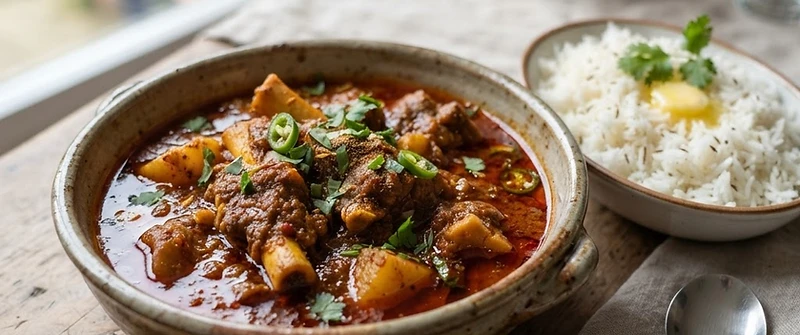
Durban Curry
The Durban Indian curry — hotter, redder, and richer than its Indian ancestor, served with rice or in a bunny.
Ideal stay
Best for
Our take
Durban curry is a fierce, oily, and deeply spiced masterpiece of necessity. It is not a delicate Indian import but a robust South African original that demands respect for its heat and its history.
Durban curry is a fierce, oily, and deeply spiced masterpiece of necessity. It is not a delicate Indian import but a robust South African original that demands respect for its heat and its history.
- Ideal Stay
- 30 to 60 minutes
- Best For
- authentic street food, intense spice, historical context, affordable local dining
- Skip If
- those seeking mild flavours, fine dining, or formal table service
- Go If
- You want to understand the soul of KwaZulu-Natal through its most honest food. It suits travellers who value flavour and cultural history over white-tablecloth refinement and who can handle significant chilli heat.
Why it's worth your time
It's not 'Indian curry' — it's Durban curry, built by the descendants of indentured labourers shipped from south India to KwaZulu-Natal's cane fields from 1860. They adapted to local ingredients and a hotter palate, and the result is redder, fiercer, and oilier than its ancestor. The tell is the red oil that separates at the edges. Order mutton or chicken at a Durban institution — Britannia, House of Curries, or Impulse by the Sea — and have it with rice or in a bunny.
What we love
The unapologetic oil slick that floats on top of the gravy is the mark of a proper Durban curry. It carries the flavour of the masala and the heat of the roasted chillies, ensuring every bite of bread or rice is coated in pure, fiery intensity.
What to know
The heat level is substantial and not for decoration. When ordering, do not expect the mild, creamy profiles found in other global curry traditions. The dish is built on a foundation of cumin, coriander, and heavy chilli. Always check if your chosen spot serves a quarter, half, or full loaf, as the quarter is the standard individual portion.
The full guide
The Anatomy of the Dish
Durban curry is defined by its red colour, its reliance on oil rather than cream or yoghurt, and a fierce heat profile. It is a hybrid cuisine born from the indentured labourers who arrived from Tamil Nadu in the 1860s. These cooks adapted their traditional recipes to the ingredients available in the sugar cane fields, incorporating local potatoes, fresh curry leaves, and a heavy hand with roasted chilli masalas. The result is a dish that is far more aggressive and oily than its Indian ancestors. You will find it served with rice or, most famously, inside a hollowed-out loaf of white bread. The bread acts as a vessel, soaking up the spicy gravy, which is why it remains the preferred way to eat it. Do not look for saffron or nuts here; look for the deep, vibrant red of a well-cooked tomato and spice base.
Eating Like a Local
To eat a bunny chow properly, you must be prepared to use your hands. It is a working-class meal designed for portability and speed, not for etiquette. You will often be served a quarter loaf, known as a kota, filled to the brim with mutton, chicken, or bean curry. The piece of bread removed to create the hollow, called the virgin, is placed on top to seal the meal. You tear off pieces of the bread from the sides and use them to scoop up the curry. It is messy, and you will likely stain your clothes, but this is part of the experience. Most places will provide a side of sambal, which is a simple salad of grated carrots, onions, and chillies, to cut through the richness of the oil and the intensity of the spice.
Finding Your Bunny
You will find the best versions of this dish in the Indian quarter of Durban or at long-standing family-run takeaways that have been operating for decades. The quality varies by operator, so look for places that are busy with locals at lunchtime. Some establishments are simple counters where you order and eat standing up or on the go, while others offer a more traditional sit-down experience. If you are unsure where to start, ask locals for their favourite bunny joint; these places often have fanatical followings similar to sports clubs. Avoid tourist-heavy areas that promise a sanitised version of the dish. Instead, seek out the spots where the air is thick with the scent of incense and chilli. Check the operating hours before you go, as many of the most authentic spots focus on the breakfast and lunch trade.
Before you book
Questions Durban Curry always raises
- Is Durban curry always extremely spicy?
- Yes, authentic Durban curry is known for its significant heat. The masala blend relies heavily on roasted chillies, which provide a persistent, deep burn. If you have a low tolerance for spice, you should ask the kitchen if they can prepare a milder version, though this is not always possible.
- What is the correct way to eat a bunny chow?
- You eat it with your hands. Tear off pieces of the hollowed-out bread from the sides and use them to scoop up the curry and the gravy. It is meant to be eaten without cutlery, often off a square of paper, and it is perfectly acceptable to get messy.
- Are there vegetarian options available?
- Yes, bean curry is a staple of the Durban curry tradition. It is often made with sugar beans and is just as rich, oily, and spicy as the meat-based versions. It is a common and highly regarded choice for those who do not eat meat.
- Should I tip when buying a bunny chow?
- Tipping is customary in South Africa. If you are eating at a sit-down restaurant, a tip of 10 to 15 percent is standard. If you are grabbing a takeaway from a counter, a small tip is appreciated but not strictly required.