Boerewors
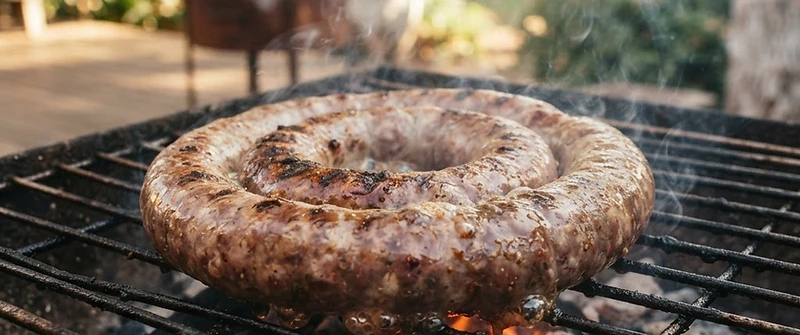
A coiled farmer's sausage of beef and pork, spiced with coriander and cooked over coals — the braai's centrepiece.
Ideal stay
Best for
Our take
Boerewors is the essential, coarse-ground soul of the South African braai. When sourced from a proper butcher and cooked with patience over open coals, its coriander-forward spice profile makes it a peerless, juicy, and deeply satisfying staple.
Boerewors is the essential, coarse-ground soul of the South African braai. When sourced from a proper butcher and cooked with patience over open coals, its coriander-forward spice profile makes it a peerless, juicy, and deeply satisfying staple.
- Ideal Stay
- 20 to 30 minutes of cooking time, plus eating time
- Best For
- a traditional braai, street-side boerie rolls, authentic South African flavour
- Skip If
- vegetarians, those seeking lean or low-fat meat options
- Go If
- You are attending a braai or seeking an authentic taste of local food culture. It is the perfect choice for anyone who appreciates high-quality, spiced, farm-style meat cooked over a wood or charcoal fire.
Why it's worth your time
The name means 'farmer's sausage,' and it belongs to the Afrikaner farming tradition that grew out of Dutch sausage-making. The coriander seed that defines its flavour travelled through the Cape Malay kitchen. It's coiled, not linked, and meant to cook over open coals until the casing crisps. Buy it from a butcher who makes it daily — never a vacuum pack — and eat it straight off the braai in a piece of bread with tomato-and-onion relish.
What we love
The dominance of coriander seed is what separates a true boerewors from a generic supermarket banger. It provides a bright, citrusy aromatic lift that cuts through the richness of the beef and pork fat, creating a flavour profile that is unmistakably South African and impossible to replicate with standard sausage spices.
What to know
Legally, boerewors must contain at least 90 percent meat and no more than 30 percent fat. Avoid vacuum-packed versions from large supermarkets if possible. Instead, find a local butcher who prepares it fresh daily. Always keep the coil intact while cooking and never prick the casing, as losing the juices results in a dry, disappointing meal.
The full guide
The anatomy of the sausage
Boerewors is a coarse-ground sausage made from beef, often mixed with pork, lamb, or goat. The name translates to farmer's sausage, reflecting its roots in Afrikaner tradition. What defines the flavour is a heavy hand with coriander seeds, often supported by cloves, nutmeg, allspice, and black pepper. By law, it must contain at least 90 percent meat and no more than 30 percent fat, ensuring a rich, moist interior. It is stuffed into natural hog or sheep casings and coiled into a continuous spiral rather than being linked into individual portions. When you buy it, look for a coarse texture where you can see the distinct pieces of meat and fat. If the meat looks like a fine, uniform paste, it is not the real thing.
Mastering the braai
Cooking boerewors is a test of patience and respect for the fire. The coil should be placed whole onto the grid over medium-hot coals. The most critical rule is to never prick the casing with a fork or knife, as this allows the precious juices to escape, leaving you with a dry, crumbly mess. Turn the coil gently once or twice during the process. It typically takes about 20 minutes to cook through, depending on the thickness of the sausage and the heat of the fire. You want the casing to be browned and crisp while the inside remains tender and juicy. If you are a guest at a braai, let the host manage the fire; it is their domain and they will know exactly when the sausage is ready.
Serving and eating
Boerewors is rarely eaten alone. At a formal braai, it is served in sections alongside pap, a firm maize porridge, and a tomato-and-onion relish that provides necessary acidity. For a more casual experience, look for a boerie roll, which is the South African equivalent of a hot dog. A length of cooked boerewors is placed inside a soft bread roll, often topped with mustard, chutney, or the classic tomato-and-onion relish. It is a messy, hands-on meal that is best enjoyed outdoors. Whether you are eating it off a paper plate at a roadside stand or as part of a Sunday afternoon gathering, the goal is to enjoy the contrast between the charred, salty skin and the aromatic, spiced meat inside.
Before you book
Questions Boerewors always raises
- Can I eat boerewors raw?
- No. Boerewors is a raw meat product and must be cooked thoroughly before consumption. It is not a cured or fermented sausage like salami, so it is unsafe to eat without proper heat treatment over a fire or on a stove.
- What is the difference between boerewors and braai-wors?
- Boerewors is a legally protected term requiring at least 90 percent meat content and specific quality standards. Braai-wors is a generic term for sausages intended for the grill; it often contains lower-quality meat, more fillers, and lacks the traditional spice profile of authentic boerewors.
- What should I serve with boerewors?
- The traditional accompaniments are pap, a firm maize meal porridge, and a tomato-and-onion relish. Many people also enjoy it with chutney, mustard, or a side of chakalaka, which is a spicy vegetable relish. It is also commonly served in a bread roll as a boerie roll.
- Why is my boerewors dry?
- Your boerewors is likely dry because the casing was punctured during cooking, allowing the juices to leak out. Alternatively, it may have been cooked over heat that was too high, or it was overcooked. Always turn it gently and avoid pricking the skin to keep the moisture inside.